
The Prathap Reddy and Apollo Hospitals Vision for a Healthier India.

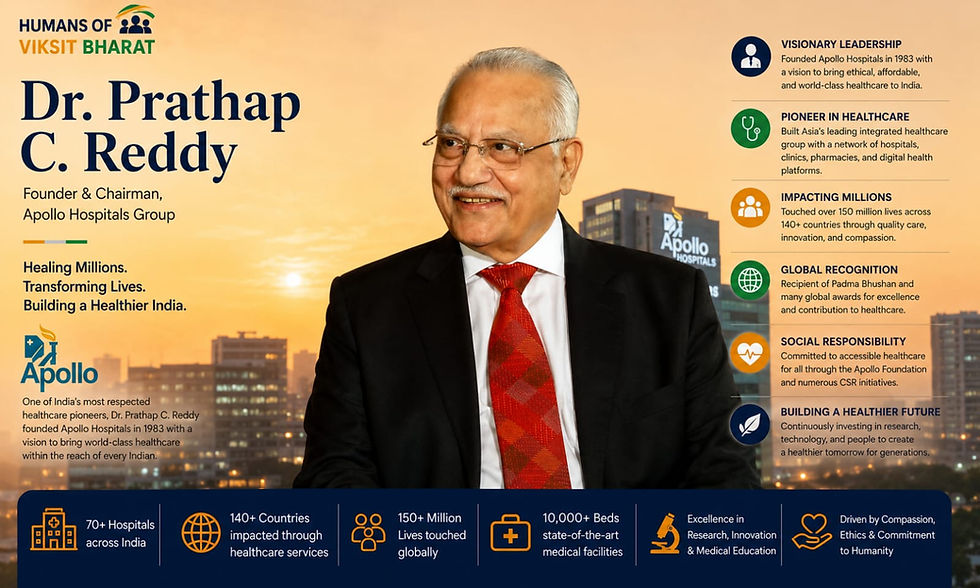
Few names are as closely associated with the rise of organised private healthcare in India as Dr. Prathap C. Reddy. When Apollo Hospitals opened its first hospital in Chennai in 1983, India's healthcare landscape was very different from what it is today. Large-scale private hospital networks were uncommon, advanced procedures were often associated with overseas treatment, and access to sophisticated medical technology was considerably more limited.
Dr. Reddy's response was to build a healthcare institution in India that could offer modern medical treatment while developing the clinical expertise, infrastructure and systems required to sustain it.
More than four decades later, the organisation that emerged from that vision is Apollo Hospitals Enterprise Limited, a publicly listed healthcare company with a broad presence across hospitals, pharmacies, clinics, diagnostics and digital healthcare.
Apollo's own corporate history describes the organisation as having been established by Dr. Prathap C. Reddy in 1983 and identifies him as the founder and chairman. The company says its mission has been to bring healthcare of international standards within the reach of individuals in India.
The evolution of Apollo is therefore not simply a story about one hospital. It is a story about the development of a healthcare ecosystem — and about how the Reddy family has participated in its expansion across successive generations.
Who Is Dr. Prathap C. Reddy?
Dr. Prathap C. Reddy is the founder and chairman of Apollo Hospitals. A cardiologist by training, he returned to India after working in the United States and eventually turned his attention to the country's healthcare infrastructure.
According to Apollo's official account, he founded Apollo Hospitals in 1983, pioneering what the organisation describes as India's private healthcare revolution.
His approach was based on an important proposition: Indians should not have to leave the country to access advanced medical treatment.
That proposition became the foundation for Apollo's business model.
The first Apollo hospital was established in Chennai, a city that already had a strong medical culture and a reputation for specialist healthcare. The organisation's historical material records that the first hospital began operations in 1983 with 150 beds.
The significance of the Chennai beginning cannot be overstated. Apollo's growth subsequently spread to other Indian cities and healthcare segments, but Chennai remained the location where the original institutional model was established.
Why Chennai Was So Important to the Apollo Story
Chennai occupies a special place in the history of Apollo Hospitals.
The first Apollo hospital opened there in 1983, establishing the foundation for what would become a nationwide healthcare organisation. Apollo's historical accounts describe the Chennai hospital as the starting point of its journey in corporate healthcare.
The early years were also important because Apollo had to attract highly skilled doctors and create a culture capable of supporting sophisticated procedures.
Apollo's own historical account highlights the contribution of cardiac surgeon Dr. M. S. Valiathan? More specifically, the company's account of its early Chennai years records the arrival of Dr. Prathap Reddy and cardiac surgeon Dr. M. R. Girinath's team, with cardiac surgery beginning at Apollo Chennai shortly after the hospital opened.
Over time, Chennai became associated with several important developments in Apollo's clinical history, including cardiac care, oncology, transplantation and advanced surgical services.
Apollo's historical timeline records several milestones in Chennai, including the introduction of coronary artery stenting in India, the establishment of specialist cancer infrastructure, and the successful performance of a multi-organ transplant in 1995.
This history helps explain why Chennai is more than simply another location in Apollo's network. It is the birthplace of the institution's corporate healthcare model.
From One Hospital to Apollo Hospitals Enterprise
The transformation from a single hospital to a diversified healthcare enterprise was gradual.
Apollo expanded its hospital operations geographically while simultaneously developing additional healthcare businesses. The organisation today describes itself as an integrated healthcare provider, with operations extending beyond traditional inpatient treatment.
According to Apollo's current corporate information, the group has more than 10,000 beds across 76+ hospitals, more than 7,000 pharmacies, over 2,500 clinics and diagnostic centres, and more than 500 telemedicine centres, supported by a workforce of more than 100,000 people.
These figures illustrate how significantly the organisation has changed since its 150-bed beginning in Chennai.
The company is no longer simply a hospital operator. Its healthcare ecosystem includes:
Hospitals and tertiary-care services
Pharmacies
Clinics and diagnostics
Digital healthcare
Telemedicine
Preventive healthcare
Education and training
Research
Home healthcare and related services
This integrated structure has become an important component of Apollo's identity.
Apollo Hospitals Enterprise Limited: A Healthcare Business
Apollo Hospitals Enterprise Limited, commonly abbreviated as AHEL, is the listed corporate entity associated with the Apollo Hospitals group.
Its business model combines healthcare delivery with supporting healthcare services.
The hospital segment remains central, but the company's financial disclosures demonstrate the breadth of its operations.
Apollo's FY2024-25 annual report reported consolidated revenue of approximately ₹217.94 billion, or about ₹21,794 crore, compared with approximately ₹190.59 billion in FY2023-24. The report also recorded an operating bed count of more than 10,000 and an occupancy rate of 68% in FY2024-25.
The same annual report recorded consolidated EBITDA of approximately ₹30.22 billion for FY2024-25.
These numbers demonstrate the scale at which Apollo now operates.
The company has evolved from a pioneering hospital enterprise into a major integrated healthcare platform with multiple revenue streams.
The Reddy Family and the Next Generation of Apollo Leadership
Dr. Prathap C. Reddy's influence is not limited to the organisation's founding years.
The next generation of the family has played major roles in Apollo's development.
His daughters — Dr. Preetha Reddy, Dr. Suneeta Reddy, Dr. Sangita Reddy and Shobana Kamineni — have each been associated with different aspects of the wider Apollo enterprise.
However, it is important to distinguish their individual responsibilities rather than treating the family as a single management unit.
Dr. Preetha Reddy: Clinical Quality and Healthcare Leadership
Dr. Preetha Reddy serves as Executive Vice Chairperson of Apollo Hospitals Enterprise Limited and is a founding member of the organisation.
Apollo identifies her with initiatives involving clinical quality, patient safety and healthcare standards. The company says she played a role in India's first hospital receiving Joint Commission International accreditation and subsequently contributed to the development of hospital accreditation standards in India.
Her role illustrates one of the central changes in healthcare management over the past few decades.
Building hospitals is only one part of healthcare. Maintaining consistent clinical standards across a large network is a much more complicated challenge.
As Apollo expanded across cities and specialties, the organisation needed common protocols, quality systems, clinical governance and performance measurement.
Preetha Reddy's work has therefore been associated particularly with the clinical and quality dimension of Apollo's growth.
Dr. Suneeta Reddy: Finance, Strategy and Expansion
Dr. Suneeta Reddy is the Managing Director of Apollo Hospitals.
Apollo's official biography states that she joined the group in 1989 and played an important role in its financial and strategic development. Her responsibilities included finance, international equity-market initiatives and the expansion of Apollo's hospital footprint.
Her career is an example of how healthcare organisations require business expertise in addition to medical expertise.
Running a large hospital network requires enormous capital investment. Hospitals need buildings, operating theatres, intensive-care units, diagnostic equipment, technology, specialist doctors, nurses and support staff.
Long-term expansion therefore depends upon financial discipline and capital allocation.
Suneeta Reddy's contribution has been particularly connected with this corporate and financial side of Apollo's development.
Dr. Sangita Reddy: Technology, Operations and Global Healthcare
Dr. Sangita Reddy serves as Joint Managing Director of Apollo Hospitals Enterprise Limited.
Apollo describes her as a healthcare entrepreneur and humanitarian who has been involved with the organisation since its early years. Her career has included responsibilities in operations, human resources, healthcare technology and broader healthcare initiatives.
Her role has become increasingly relevant as healthcare moves from a hospital-centric model toward digitally connected care.
Modern healthcare involves electronic medical records, telemedicine, remote monitoring, artificial intelligence, digital consultations, online pharmacies and data-driven clinical decision-making.
Apollo's wider ecosystem includes Apollo 24/7, which is part of this digital-health transition.
Sangita Reddy's leadership therefore reflects the organisation's effort to combine its traditional hospital infrastructure with newer technology-enabled healthcare models.
Shobana Kamineni and the Wider Apollo Ecosystem
Shobana Kamineni, another daughter of Dr. Prathap C. Reddy, has also held important leadership roles within the wider Apollo ecosystem.
Apollo identifies her as a promoter director of Apollo Hospitals Enterprise Limited and notes her involvement in the development of major verticals within the group and the Apollo 24/7 digital healthcare platform.
Her career demonstrates another aspect of the family's approach: diversification.
Healthcare is no longer limited to what happens inside a hospital.
Consumers increasingly interact with healthcare providers through smartphones, online consultations, digital prescriptions, diagnostic services and home-based care.
The development of digital healthcare platforms allows a hospital group to maintain relationships with patients before admission, after discharge and even when no hospital admission is required.
Apollo's Integrated Healthcare Model
One of Apollo's most important strategic developments has been the movement toward integrated healthcare.
Traditionally, healthcare businesses were often divided into separate categories:
Hospital → Pharmacy → Diagnostic centre → Doctor consultation
Apollo has increasingly attempted to connect these components.
A patient may discover a health concern through preventive screening, consult a physician, undergo diagnostic testing, receive treatment at a hospital, obtain medicines through a pharmacy and subsequently use digital or home-health services.
This creates a healthcare continuum.
The company's current corporate description reflects this broader approach, covering hospitals, pharmacies, primary care and diagnostics, telemedicine, health insurance-related services, education and digital platforms.
Apollo and Preventive Healthcare
Another important element of the Apollo story is preventive healthcare.
Dr. Prathap Reddy's vision has increasingly extended beyond treating patients after illness appears.
Apollo has promoted preventive health checks for decades. In 2019, the company announced recognition for completing 20 million health checks and highlighted its role in promoting preventive healthcare through the Master Health Check concept.
The focus is increasingly relevant because India's disease burden is changing.
Heart disease, cancer, diabetes and other non-communicable diseases are major healthcare concerns.
Apollo's 2026 Health of the Nation report has emphasised earlier detection and personalised preventive healthcare. Apollo executives have also highlighted the importance of screening for cardiovascular disease and cancer.
This reflects a wider shift in healthcare:
Reactive healthcare asks, "How do we treat the disease?"
Preventive healthcare asks, "How can we identify and reduce the risk earlier?"
The second approach is likely to become increasingly important as India's population ages and healthcare demand grows.
Technology and the Future of Apollo Healthcare
Technology is another major pillar of Apollo's future.
Large hospital groups are increasingly using technology in diagnostics, surgery, patient monitoring, telemedicine, electronic health records and personalised medicine.
Apollo's leadership has repeatedly emphasised technology as a tool for expanding access and improving care.
The organisation has also invested in digital healthcare through Apollo 24/7 and related platforms.
For a healthcare company with thousands of hospital beds and millions of patient interactions, technology can potentially improve coordination between different parts of the healthcare ecosystem.
Artificial intelligence is also beginning to influence areas such as medical imaging, clinical decision support, hospital operations and preventive analytics.
However, technology does not replace doctors.
The challenge for healthcare providers is to use technology to augment clinical expertise while preserving patient safety, medical accountability and human interaction.
Apollo's Scale in 2026
Apollo's latest publicly available figures demonstrate how dramatically the organisation has expanded.
Its FY2024-25 annual report recorded:
10,209 beds in the group's reported bed-count series
68% operating occupancy
₹217.94 billion consolidated revenue
₹30.22 billion consolidated EBITDA
604,000 discharges
7.0 million outpatients
More than 6,600 physical pharmacies in the FY2024-25 reporting period
The annual report provides these figures across its five-year operating and financial overview.
More recent reporting indicates that Apollo continued to grow in 2026.
Reuters reported in August 2026 that Apollo's revenue from operations rose 20.6% year-on-year to ₹70.43 billion for the quarter ended June 30, 2026, while net profit increased 34% to ₹5.81 billion. The company also announced plans to add more than 5,800 beds over the following five years.
These figures show that Apollo's expansion is continuing rather than representing merely the legacy of its early success.
Why Apollo Continues to Matter to Indian Healthcare
The significance of Apollo extends beyond its financial size.
When Dr. Prathap Reddy established the first Apollo hospital in Chennai, the idea of a large professionally managed private healthcare network was relatively new in India.
Apollo's model demonstrated that private healthcare could be organised around large-scale hospitals, specialist doctors, advanced technology and professional management.
The organisation itself says that its model inspired hundreds of other high-quality hospitals and contributed to the development of India's private healthcare sector.
Whether one looks at Apollo from the perspective of healthcare, business or entrepreneurship, its impact is significant.
It helped change the expectation that advanced medical treatment necessarily required travelling abroad.
It also demonstrated the potential for Indian healthcare companies to build specialised centres capable of treating complex diseases.
The Business Challenge: Growth Versus Accessibility
Apollo's success also illustrates a fundamental challenge facing private healthcare.
Advanced healthcare requires expensive infrastructure and highly trained professionals.
At the same time, India has a huge population with widely varying income levels.
The long-term question for Apollo and other private hospital companies is therefore not simply how to grow.
It is how to grow while keeping healthcare accessible, maintaining quality and ensuring that clinical outcomes remain central to decision-making.
Dr. Prathap Reddy has consistently presented affordability and accessibility as part of Apollo's founding vision. The company's stated mission is to make international-standard healthcare accessible to individuals.
That mission remains relevant as the company enters a new stage of expansion.
The Importance of the Reddy Family's Succession Model
Family-owned or family-led enterprises often face a difficult question: how does a founder's vision survive after the founder's active leadership changes?
Apollo has addressed this by gradually giving different members of the next generation distinct responsibilities.
Rather than placing the entire business under one family member, the Reddy family's leadership structure has historically involved different individuals focusing on different areas.
Preetha Reddy has been associated strongly with clinical quality and patient care.
Suneeta Reddy has focused significantly on finance, strategy and business growth.
Sangita Reddy has worked extensively across operations, technology and healthcare transformation.
Shobana Kamineni has been associated with several businesses and digital healthcare initiatives.
This division of responsibilities has helped the family enterprise develop multiple leadership capabilities.
Apollo's Global Healthcare Ambition
Apollo is no longer exclusively an Indian healthcare story.
The company says patients from more than 140 countries have used its services, reflecting the growth of medical travel and international healthcare demand.
India has become an increasingly important destination for international patients seeking complex medical procedures at comparatively competitive costs.
Apollo's combination of specialist doctors, advanced infrastructure and established hospital brands has helped it participate in this market.
Chennai, once again, has an important role because the city has long been a centre for medical tourism in India.
Its combination of specialist hospitals, medical professionals and international connectivity has made Chennai an important healthcare destination.
What the Future Could Look Like for Apollo Hospitals Enterprise
The next chapter for Apollo is likely to be defined by several trends.
1. More Hospital Capacity
Apollo has announced significant future bed expansion. Reuters reported in August 2026 that the company planned to add more than 5,800 beds over five years.
This reflects increasing demand for complex healthcare services.
2. More Preventive Healthcare
Early diagnosis and risk prediction are becoming increasingly important.
Instead of waiting until a disease becomes severe, healthcare providers can use screening and diagnostics to identify risks earlier.
3. Greater Digital Integration
Digital consultations, online pharmacy services, electronic medical records and remote healthcare can connect patients with healthcare providers beyond physical hospitals.
4. More Complex Clinical Care
Apollo is likely to continue investing in high-acuity specialties such as oncology, cardiology, transplantation, neurosciences and advanced surgery.
5. Artificial Intelligence
AI is likely to become more important in diagnostics, workflow management, personalised medicine and preventive healthcare, although clinical validation and patient safety will remain essential.
From Prathap Reddy's Vision to a Multi-Generational Healthcare Enterprise
The history of Prathap Reddy and family is ultimately the story of how a healthcare vision became an institution.
In 1983, Dr. Prathap C. Reddy established Apollo Hospitals in Chennai at a time when India's private hospital sector was still developing.
That first hospital created the foundation.
The subsequent decades brought expansion into multiple cities, medical specialties, pharmacies, diagnostics, preventive healthcare, education and digital healthcare.
The next generation of the Reddy family became increasingly involved in the organisation, with Preetha Reddy, Suneeta Reddy, Sangita Reddy and Shobana Kamineni contributing in different leadership capacities.
Today, Apollo Hospitals Enterprise operates on a scale that would have been difficult to imagine when the first 150-bed hospital opened in Chennai.
The FY2024-25 annual report shows a business with more than 10,000 beds and consolidated revenue approaching ₹21,800 crore. Recent 2026 results indicate that growth is continuing, with additional hospital capacity planned.
Yet the most important part of the Apollo story may not be the numbers.
It is the change in India's healthcare expectations.
Apollo helped establish the idea that advanced medical care could be built at scale within India. Its evolution from a Chennai hospital into an integrated healthcare enterprise mirrors the broader transformation of Indian healthcare itself.
For Dr. Prathap C. Reddy, the original objective was to make world-class healthcare available in India.
For the next generation, the challenge is broader: to make healthcare increasingly accessible, preventive, technology-enabled, clinically advanced and sustainable while preserving the trust that has been built over more than four decades.
That is what makes Apollo Hospitals Enterprise and the Reddy family's healthcare journey significant not only as a business story, but also as a chapter in the history of modern Indian healthcare.
Kritika Thakur
Youth Ambassador, Viksit bharat , YOUTH COUNCIL


Comments