
The Firodia Family and Bajaj Finserv: Building India’s Industrial and Financial Future
- Anagh Vasishtha
- Jul 13
- 8 min read

Introduction: The Convergence of Manufacturing Might and Financial Innovation
The story of India's industrialization is written in the cities that became hubs of enterprise.
In Maharashtra, Pune emerged as the "Detroit of the East," a manufacturing powerhouse that helped build India's mobility infrastructure.
Over the past two decades, however, a parallel transformation has taken place.
Pune has also evolved into a major center for digital finance, driving financial inclusion and expanding access to credit across the country.
This convergence of heavy manufacturing and digital finance is not an accident of geography.
It is the result of a shared legacy of entrepreneurial families who helped build both the physical and financial foundations of modern India.
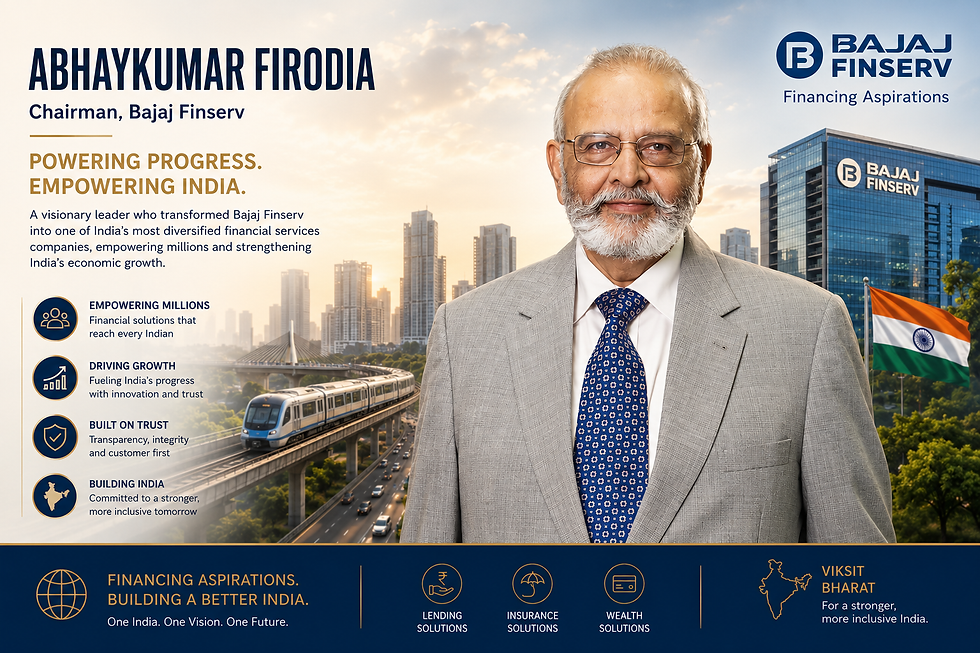
Foremost among these legacies is the Firodia family, led by Dr. Abhaykumar Firodia, whose historic partnership with the Bajaj family played a major role in establishing Pune’s industrial base.
While the Firodia family has remained focused on manufacturing leadership through Force Motors and Jaya Hind Industries, their deep strategic and financial investment in the Bajaj Group links them to one of India’s most significant financial success stories: Bajaj Finserv.
This article explores how the industrial foundation built by the Firodia family and the digital financial revolution led by Bajaj Finserv are working together to drive economic empowerment and financial modernization across India.
As the nation advances toward the vision of Viksit Bharat 2047, this powerful combination of manufacturing and finance continues to support inclusive growth and long-term prosperity.
Early Life & Background: The Heritage of Dr. Abhaykumar Firodia
Dr. Abhaykumar Firodia was born into a family deeply involved in India’s independence movement and early industrialization efforts.
His father, Navalmal Firodia, was a pioneering industrialist and a close associate of
Mahatma Gandhi and Jamnalal Bajaj.
Navalmal believed that political independence would have limited meaning without economic self-reliance.
This conviction inspired him to contribute to the development of India’s domestic automobile industry.
Growing up in this environment of nation-building and entrepreneurship, Abhaykumar Firodia developed a strong appreciation for engineering excellence, capital discipline, and long-term industrial development.
He studied at the prestigious Brihan Maharashtra College of Commerce (BMCC), Pune, and later earned a doctorate.
When he joined the family business during the 1970s, India was operating under a highly regulated economic framework dominated by licensing restrictions and limited access to capital.
These conditions taught him the importance of operational efficiency, local sourcing, and strategic partnerships.
His early experiences shaped a leadership philosophy centered on the belief that industrial manufacturing forms the foundation upon which financial services and modern economies are built.
Building the Enterprise: The Evolution of Jaya Hind Industries and Force Motors
The Firodia family’s business legacy is anchored by two flagship enterprises: Jaya Hind Industries and Force Motors.
Jaya Hind Industries was established in 1947 with the objective of manufacturing high-precision aluminum castings and automotive components.
Under the guidance of Abhaykumar Firodia, the company became one of India’s leading automotive component manufacturers.
It pioneered advanced pressure die-casting technology and emerged as a trusted supplier to both domestic and international automobile manufacturers.
Force Motors traces its origins to Bajaj Tempo, a company established in 1958 through a collaboration between the Firodia and Bajaj families.
The venture focused on manufacturing light commercial vehicles that could support India’s growing transportation needs.
Under the operational leadership of the Firodia family, the company introduced the iconic Tempo three-wheeler.
The vehicle became a vital component of urban and rural transportation networks across the country.
In 2005, Bajaj Tempo was renamed Force Motors, reflecting its broader ambitions and expanded product portfolio.
The company diversified into multi-utility vehicles, agricultural tractors, light commercial vehicles, and specialized transportation solutions.
The Firodia family’s commitment to engineering excellence was further recognized when global automotive brands such as Mercedes-Benz and BMW selected Force Motors to manufacture and test high-precision engines for their Indian operations.
This achievement highlighted the company’s advanced manufacturing capabilities and world-class quality standards.
Industry Leadership: The Historical Synergy with the Bajaj Group
The relationship between the Firodia and Bajaj families represents one of the most influential partnerships in Pune’s industrial history.
For decades, the two families worked together to develop Bajaj Auto and Bajaj Tempo, creating an industrial ecosystem that attracted suppliers, skilled workers, investors, and entrepreneurs to the region.
Although operational management responsibilities were divided during the late 1960s—with the Firodia family taking control of Bajaj Tempo and the Bajaj family continuing to lead Bajaj Auto—their strategic and financial connections remained intact.
The Firodia family’s holding company, Jaya Hind Industries, retained a significant equity position in Bajaj Holdings & Investment Limited.
Through this structure, the family maintained exposure to the growth of both Bajaj Auto and Bajaj Finserv.
As a result, the Firodia family became one of the largest minority shareholders within the broader Bajaj ecosystem.
This investment strategy created a unique synergy.
The industrial wealth generated through manufacturing activities was complemented by the extraordinary value creation resulting from the Bajaj Group’s expansion into financial services.
The relationship demonstrates how industrial capital can be redeployed to support innovation in adjacent sectors, fueling broader economic development.
Innovation & Transformation: Bajaj Finserv’s Digital Finance Revolution
While the Firodia family concentrated on manufacturing, Bajaj Finserv, under the leadership of Sanjiv Bajaj, spearheaded a transformation in India’s financial services sector.
Established in 2007 following the demerger of Bajaj Auto, Bajaj Finserv was designed to capitalize on growing opportunities in consumer finance, insurance, and wealth management.
Sanjiv Bajaj recognized that traditional banking models were often too slow, expensive, and inaccessible for large segments of India’s population.
His vision was to leverage technology, data analytics, and digital platforms to democratize access to financial services.
One of Bajaj Finserv’s most successful innovations was the introduction of the No-Cost EMI model.
This financing solution enabled consumers to purchase electronics, appliances, and other products through affordable installment plans without interest costs.
The company also developed sophisticated underwriting algorithms capable of evaluating customer creditworthiness within seconds.
By utilizing alternative data sources and digital verification systems, Bajaj Finserv significantly expanded access to formal credit.
This technology-driven approach culminated in the creation of the Bajaj Finserv App, a financial super-app that integrates loans, insurance, investments, and payment services into a single digital ecosystem.
Today, the platform serves millions of consumers and businesses across India.
Contribution to India’s Economic Growth: Democratizing Capital for the Masses
A developed economy requires broad participation from middle-income and emerging-income households.
Consumption, entrepreneurship, and financial inclusion all depend on access to capital.
Bajaj Finserv’s greatest contribution to India’s economic development has been the democratization of credit and financial services.
Historically, many Indian households and small businesses faced significant barriers when seeking formal financing.
Traditional banking institutions often prioritized large corporations and affluent customers.
Bajaj Finserv helped bridge this gap by providing accessible financial solutions to underserved segments of society.
Through its subsidiary Bajaj Finance Limited, the company has built one of India’s largest customer franchises, serving more than 80 million clients.
Its digital lending platform has enabled millions of first-time borrowers to enter the formal financial system.
Access to credit has empowered individuals to purchase productive assets, finance higher education, launch businesses, and manage unexpected medical expenses.
The company has also expanded financial protection through insurance offerings.
Bajaj Allianz General Insurance and Bajaj Allianz Life Insurance provide products designed to meet the needs of both urban and rural populations.
These solutions help households protect themselves against financial shocks and unforeseen risks.
By expanding access to credit and insurance, Bajaj Finserv is contributing to a stronger, more resilient, and consumption-driven economy.
The industrial investments of the Firodia family further complement this progress by supporting manufacturing activity, employment generation, and regional development.
Employment Generation & Ecosystem Impact: Sustaining Livelihoods in Pune and Beyond
The combined influence of the Firodia family’s manufacturing enterprises and Bajaj Finserv’s financial services network has generated substantial employment opportunities.
Force Motors directly employs thousands of engineers, technicians, assembly workers, and manufacturing professionals across facilities located in Pune, Pithampur, and Chennai.
The company’s emphasis on localization has also supported a large ecosystem of automotive suppliers, machine shops, and component manufacturers.
Bajaj Finserv has similarly created employment through its nationwide financial services network.
The organization employs professionals across technology, customer service, sales, analytics, insurance, and lending operations.
Its digital platforms support thousands of retail partners who use financing solutions to increase customer purchases and improve business performance.
The company’s services enable local retailers, entrepreneurs, and small businesses to access customers and capital more efficiently.
Together, these manufacturing and financial ecosystems contribute significantly to regional development and livelihood creation.
ESG, Sustainability & Social Impact: Commitment to Community and Clean Power
Both the Firodia family and Bajaj Finserv have integrated sustainability and social responsibility into their long-term strategies.
Force Motors has implemented multiple environmental initiatives aimed at reducing its ecological footprint.
These include investments in solar power generation, energy-efficient production systems, and advanced waste management technologies.
The company has also adopted responsible manufacturing practices designed to minimize resource consumption and environmental impact.
The Firodia family’s charitable trusts support educational institutions, healthcare programs, and heritage preservation projects throughout Maharashtra.
These initiatives focus particularly on improving opportunities for rural communities.
Bajaj Finserv has similarly embraced environmental responsibility.
The company is among the leading corporate investors in wind energy and operates renewable energy assets that contribute clean electricity to regional power grids.
Its corporate social responsibility initiatives focus on youth skill development, women’s empowerment, water conservation, and community welfare.
By aligning business growth with environmental stewardship and social impact, both organizations are contributing to sustainable and inclusive development.
Leadership Philosophy: Strategic Stewardship and Wealth Creation
The leadership philosophy of both the Firodia family and Bajaj Finserv is rooted in strategic stewardship, financial discipline, and long-term value creation.
Dr. Abhaykumar Firodia has consistently emphasized conservative financial management and responsible capital allocation.
Under his leadership, Force Motors has maintained a strong balance sheet while continuously investing in technology, product development, and manufacturing capabilities.
He believes that industrial leadership requires patience, discipline, and a commitment to quality rather than a focus on short-term profits.
This philosophy closely aligns with Bajaj Finserv’s approach to financial services.
Sanjiv Bajaj has built the organization around strong risk management systems, operational efficiency, and disciplined growth.
Technology investments are designed not only to improve customer experience but also to strengthen underwriting accuracy and portfolio quality.
This commitment to sound governance and capital stewardship has enabled both organizations to create substantial value for shareholders, employees, and customers.
Role in Viksit Bharat 2047: Empowering the Next Billion Consumers
India’s journey toward becoming a developed nation by 2047 will require both financial inclusion and industrial competitiveness.
A modern economy depends on citizens having access to formal financial services, insurance protection, digital payments, and affordable credit.
At the same time, a strong manufacturing base remains essential for employment generation, exports, and technological advancement.
Bajaj Finserv is helping bring the next billion consumers into the formal financial system by expanding digital financial services into Tier 2, Tier 3, and rural markets.
Its technology-driven platforms are making financial services more accessible than ever before.
Simultaneously, the Firodia family continues to strengthen India’s industrial foundation through ongoing investments in manufacturing innovation and engineering excellence.
This combination of industrial capability and digital finance represents a powerful model for sustainable economic development.
Together, these institutions are helping build a balanced and resilient economy capable of supporting India’s ambitions as a global leader by 2047.
Lessons for Future Entrepreneurs: Capital Stewardship and Long-Term Investing
The journey of the Firodia family and the success of Bajaj Finserv offer several valuable lessons for aspiring entrepreneurs and business leaders.
Industrial Foundations Are Essential
While digital services and technology businesses are important, long-term economic growth depends on a strong manufacturing sector that creates jobs and supports innovation.
Focus on Capital Efficiency
Disciplined capital allocation and effective risk management are critical for building sustainable businesses.
Embrace Technology to Scale
Technology can transform traditional industries by improving efficiency, customer experience, and market reach.
Value Long-Term Partnerships
The enduring relationship between the Firodia and Bajaj families demonstrates how trust, mutual respect, and strategic collaboration can create long-term value.
Conclusion: The Legacy of a Twin Dynasty
The industrial and financial evolution of Pune reflects the vision, discipline, and entrepreneurial spirit of some of India’s most influential business families.
The Firodia family, under the leadership of Dr. Abhaykumar Firodia, has built a legacy of manufacturing excellence that demonstrates the strength of Indian engineering and industrial capability.
Their historic association with the Bajaj Group and continued investment in its growth have linked them to the extraordinary success of Bajaj Finserv, a company that has transformed consumer finance and digital lending in India.
As India progresses toward Viksit Bharat 2047, the integration of industrial production and digital finance will remain a critical driver of economic development.
The combined legacy of these Pune-based business dynasties illustrates how private enterprise can build both the physical infrastructure and financial networks necessary for national progress.
Their journey serves as a powerful example of how manufacturing excellence, financial innovation, and long-term stewardship can work together to create a prosperous, inclusive, and self-reliant future for India.



Comments